Search This Blog

Showing posts with label Nisse. Show all posts

Sunday, December 13, 2015

The Darkest Night of the Year: "Lussi Long Night" and the Celebration of Lucia

Born in Syracuse in Sicily in the 280s, there are several legends surrounding the story of the Holy Sancta Lucia (eng. St. Lucy). Although it remains unclear what actually happened to her, it is however certain that she suffered martyrdom December 13th, somewhere between 303 and 310 AD. The various legends say that Lucia prayed to God that her mother, who was terminally ill, would get well. When her prayers were granted, Lucia devoted herself to God, swore to live in chastity and used her dowry to bring food and supplies to the impoverished people of Syracuse. In order to have her arms free when she was going down the dark hallways in Syracuse, it was said that she wore a wreath of candles, earning her the epithet, “the luminous".

Some say that it was a scorned suitor who allegedly reported her actions, after having been repeatedly rejected by the beautiful girl. In a time in when Christianity was banished, and devoted Christians were persecuted, this was a severe accusation. The city’s governor promptly commanded that Lucia should be burned at the stake, unless she voluntarily chose to renounce her faith. The girl refused this “offer”, yet when the day came, the fire did not touch Lucia, and several attempts had to be made before the executioners succeeded in ending the life of the poor girl – eventually she was killed by a sword through her throat. After her passing, Lucia was canonized, and to this day the martyrdom of Sancta Lucia is commemorated on the 13th of December. 
Master of the Figdor Deposition (1480–1500, The Martyrdom of St Lucy, detail. Formerly part of a wing of an altarpiece.

In Scandinavia, the anniversary of Lucia was established after the implementation of Christianity – here however, the typical elements of the catholic celebration were fused together with ancient Scandinavian traditions. The celebration of the winter solstice had taken place already among the Norsemen, and many of the Norse traditions and conceptions were continued for the generations to come. In the Nordic lands, December was known to be the darkest time of the year and, giving the circumstances, it was only natural that the common belief system was characterized by the long ranging darkness.

The night between the 12th and the 13th was believed to be of particular importance, being the longest night of the year, and therefore a night when powerful and supernatural forces were at work. According to the folk belief, this was for instance the only night of the year when animals were able to talk to each other. After midnight, the barn became a bustling social “hot spot”, in which all the animals were finally able to catch up on their gossip. This might also be an explanation why Lucia was believed to be a part of the dark forces dominating this particular night. In addition, a confusion of St. Lucia ("the luminous”) and the diabolic Lucifer ("the bringer of light") arose in Norwegian and Swedish folklore, as a creature known by the name of Lussi.

It was also on this particular evening the beginning of Christmas was initiated, and it was therefore important that people were well underway with all the Christmas preparations. Threshing and spinning should already have been completed, and Christmas baking was expected to be well underway. Late at night between the 12th and 13th of December, Lussi came with an entourage of subterranean beings to ensure that all activities were on schedule. In this sense, Lussi may perhaps best be described as contemporary labor inspector, which in fact gives her something in common with the nisse. And as with the nisse, Lussi was also known for her erratic nature – if people had neglected their “to-do list”, all hell would break loose. Lussis fury would be inevitable, and she would press her white, distorted face against the windowpane, shrieking out her disapproval. At other times, she could also enter the house through the chimney, or she would simply tear down the entire chimney. The most unfortunate ones could even risk getting abducted by this creature, and led far away. All had to watch out when Lussi came stirring, bewitching and startling poor and rich alike.

Lussi langnatt (eng. ‘the long night of Lussi’), was therefore not an evening that was much looked forward to, and if possible, most people preferred to remain indoors. 

The modern day Lucia

Luckily, the Lucia known in Scandinavia today, is quite different from the previous creature of Lussi. In Sweden in particular, the tradition of celebrating “luciadagen” is deeply rooted, and may have arisen with sailors who brought this Italian custom to the Nordic lands. Early in the morning, the oldest daughter of the house would bring her parents breakfast in bed, in the form of coffee, hot mulled wine and traditional “lussekatter” (Saffron Buns). This is a custom that dates back to the 1880s, and originally, she would be wearing white, with a candlelit crown on her head just as Lucia.

The first recorded appearance of a white-clad Lucia in Sweden was in a country house in 1764. The custom did not become universally popular in Swedish society until the 1900s, when schools and local associations in particular began promoting it. Around the 1930s, we meet the first modern Lucia-processions in the streets of Stockholm, with the luminous Lucia in front, followed by an entourage of girls and boys dressed in white. Originally, this was actually a publicity stunt of one of the city's daily newspapers, yet it became so popular that it quickly spread to several parts of the world. Nowadays, the Lucia-celebration remains a widely popular happening throughout Scandinavia, and during the last decades, it has increasingly become a celebration for the youngest. In schools, kindergartens, hospitals and other public institutions there are processions with children dressed in white, carrying candles baskets of lussekatter in their hands. In Sweden, even a national Lucia is proclaimed, and each town and village elects their very own Lucia.

It is quite a sight, standing in a pitch black room when a Lucia-procession enters singing, wearing long, white robes with burning candles in their hands. In front we have Lucia herself, wearing her candlelit crown and a red ribbon around her waist, accompanied by a number of “handmaidens”. Though many songs are dedicated to this celebration, the one most commonly used throughout Scandinavia was really a Neapolitan folk song. The earliest version dates back to 1835, when the Italian composer Teodoro Cottrau translated the text from Neapolitan dialect to standard Italian. Today, it remains as the official song of the Lucia-celebration, known by Scandinavians by heart. It is a song that truly captures the heart of the celebration, and bears witness of the brighter, warmer days to come. 

The night treads heavily
around yards and dwellings
In places unreached by sun,
the shadows brood
Into our dark house she comes,
bearing lighted candles,
Saint Lucia, Saint Lucia.


Wish to try out the traditional lussekatter (Saffron Buns)?

Ingredients (25 buns)

1 g (1/28 oz) saffron threads (optionally, turmeric may also be used)
50 g (2 oz) yeast
200 g (7 oz) sugar
300 ml (1½ cup) milk
1 egg
150–200 g (5–7 oz) butter
1 tsp salt
750 g (26 oz) flour
100 g (3½ oz) raisins

Glaze:

1 egg
2 tbs water

Preparation:
To make ‘Lucia cats’ (lussekatter), grind the saffron along with a cube of sugar, using a mortar and pestle. (For those who think ahead: drip a little cognac on top, and let stand a few days.) Crumble the yeast in a bowl and stir in a few tablespoons of milk. Melt the butter and pour on the milk.


Add the rest of the ingredients, except the raisins, and knead the dough in a dough mixer for 10 minutes. Carefully mix in most of the raisins, cover the dough and let it rise for 30 minutes at room temperature.

Divide the dough into 25 pieces and roll the buns in an oblong shape, about 10 cm (4 in) long. Cover them and let rest for 10 minutes, then roll them twice as long and twist the ends of each bun in opposite directions to form a sort of figure 8. Put one raisin in the middle of each half figure 8.

Place on a greased baking sheet and let rise under a towel for about 90 minutes, or until the buns have doubled in size. Bake in the oven (220°C/425°F) for 5 minutes. Beat together the egg and water, brush the mixture on the buns. Allow to cool on the baking sheet.


The concept of December 13th as “the longest night of the year” is also a symbol of the constant battle between the light and dark forces of the world – the December solstice may in this sense be consider as a mighty metaphor that lightness eventually prevails. The traditional pastry lussikatter, which holds such an important part of the celebration of Lucia, may actually be consider as an extension of this metaphor.  
Why?
Lussekatter are baked with saffron, which color is considered as a representation of the sun and the light. Furthermore, the spiral forms of the pastry represent the ancient symbols of the solar, as well as of life itself.

Sources:

Friday, February 13, 2015

Long after he had fallen asleep, they had heard them rattle and stir throughout the night...

I have come to understand, more than once, that invisible forces are with us. Now I want to tell you about something that has happened to me one spring, many years ago.
I was herding a cow that was soon to calve, and looked after her day and night. One evening, I was in the barn one last time before going to bed. When everything appeared to be as it should be, I went to sleep safely reassured.
Not long after I fallen asleep though, I heard someone shouting my name from the outside: "Ragndi!" I jumped up and ran to the barn. The cow had born a fine calf.
I believe to this day that there was someone who wished to notify me that night.
Told by Ragndi Moen from Oppdal (Norway), to Knut Hermundstad

The term folklore implies, in the traditional sense, a number of ideas about supernatural creatures and forces that intervened, and lived side by side with human existence. When reading the tales and legends of the folk belief, it is therefore of great value to have a certain understanding about the mentality of the old Nordic society.  

Already among the Norsemen, stories existed about invisible creatures that influenced their everyday lives. The dwarfs, for example, were small, humanlike beings that lived in the mountain and ruled over the metals – gold, silver, copper and iron. They were skilled blacksmiths, and did not tolerate sunlight. They could also be both vindictive and cunning if they were overthrown; in variant ways, they would try to prevent greedy people to extract precious metal, by making the mining dangerous and troublesome. Meanwhile, they could also be of great assistance, helping out with everyday work, and even saving lives if necessary. There were no chances of ever escaping the encounters with these beings, and therefore people adapted the best they could.


Theodor Kittelsen, "Echo" (1888). Popularly it was called "dvergmål" (dwarf tongue), the alleged voices that belonged to the creatures in mountain – this phenomenon we know today as echo. Do you see the old man in the mountain?

It is important to bear in mind that just a century ago, people were dominated by nature and weather conditions in a completely different way than nowadays, especially in places of work. The social aspect of everyday life naturally consisted of interactions with animals (and potential neighbors), but also by an uncontrollable and unpredictable nature. Very clear distinctions were made between the human sphere, and the precarious wilderness. All near surroundings, consisting of home fields with houses and construction, represented the safe, domestic and anthropogenic domain. What existed beyond this sphere however – mountains, moorlands, forests or sea – consisted of uncultivated land, and represented an unknown and unsafe realm. Nature was given will and intention through a variety of "residents", who could be both destructive, as well as auspicious.

In the folklore, the subterraneans – de underjordiske – is a common term for the creatures that inhabited these lands. They belonged to a remote, outer nature, yet kept close enough for people to notice their existence. Their home ground where often situated near farms and shielings, and they frequently intervened during the everyday life; hunting and fishing, in cattle raising and mining, in addition to all aspects of farm work. These creatures were highly erratic, and if they were opposed, or norms were not followed, they could also become dangerous and make life quite bothersome for the people around them. (The old stories about the "nisse" can depict this aspect for us.) In many ways they represented an important link with the forces of nature, and it was therefore important to approach them in a respectful and positive manner.

The Norwegian writer and scholar Per Christen Asbjørnsen wrote about an encounter with these forces during a journey to the county of Møre og Romsdal on the Norwegian West Coast. It was the summer of 1847, and fairly late at night. In most farms there were no one home, as people were away to work on the mountain dairy. Finally though, Asbjørnsen found a place where he could detect the sound of human voices. Weary and anticipative, he knocked on the door. After much noise and long lasting discussions coming from inside the house, the door finally opened and a man appeared in the doorway. Rather baffled he apologized to Asbjørnsen, explaining that he believed it was “scoundrels” lurking about. The following morning though, the housewife revealed the real reason for this inhospitable reception; they did not dare disturb the subterraneans so late at night, she said. These beings required complete and utter silence after dark, and that evening they were clearly agitated. Long after Asbjørnsen had fallen asleep, the housewife told, they had heard them rattle and stir throughout the night.

The French folklorist Virginie Amilien has written that the boundaries between reality and fantasy is very transparent in the old folklore, probably because man has never been able to fantasize without references. The degree of fantasy that is reflected in the folktales may therefore not merely be a product of pure imagination, while also being equivalent to a close reality. Simultaneously as they can be read as a reflection of the former rural community, they also depict a reality that is constantly on the move between the imaginary, and the pragmatic. The writings of Asbjørnsen illustrate this aspect, as well as showing us how people made a quite practical approach when encountering these beings. By sustaining a set of social rules and guidelines derived from the human sphere, it was not only possible to communicate with them – it could also contribute to an increased sense of being able to influence circumstances that essentially was beyond human control.

This is a reality that may not be recognized today, because our culture has changed so much since the folktales were first told. When reading the legends and fairytales we must therefore take into account that human culture, not to mention our perception of reality, is perpetually on the move. 


It was an unknown and unsafe realm... August Cappelen, "Foss i nedre Telemark" (1852)

Sources:
  • Amilien, Virginie. "Den annen verden i norske folkeeventyr." I Nord-Nytt - nordisk tidsskrift for folkelivsforskning. Nr. 65. 1996.
  • Asbjørnsen, P. Chr. Tradisjonsinnsamling på 1800 -tallet. Stipendmeldingar frå P. Chr. Asbjørnsen, J. Moe, L. Lindeman, S. Bugge, M. Moe. Norsk folkeminnelags skrifter nr. 92. Universitetsforlaget. Oslo 1964.
  • Christensen, Olav. Bergteken. Nye vegar til gamle segner. Norsk folkeminnelags skrifter nr. 148. Norsk folkeminnelag/Aschehoug 2000.
  • Christensen, Olav; Eriksen, Anne. "Landskapsromantikk og folketradisjon." I Norveg – Tidskrift for etnologi og folkloristikk. Nr. 2 1993. Tema: Landskap.
  • Hodne, Ørnulf. Norsk folketro. J.W. Cappelens Forlag. 1999.
  • Solheim, Svale. Norsk sætertradisjon. H. Aschehoug & Co. Oslo 1952.

Monday, December 8, 2014

The "Nisse"

In modern day Scandinavia, nissen or tomten is first and foremost associated with the Christmas holidays, and often perceived as a Scandinavian version of Santa Claus. This association is however rather misleading - it is also important not to mistake him with somewhat similar creatures, like elves or goblins. Nissen stands out on his own, and represent a quite different set of values. 

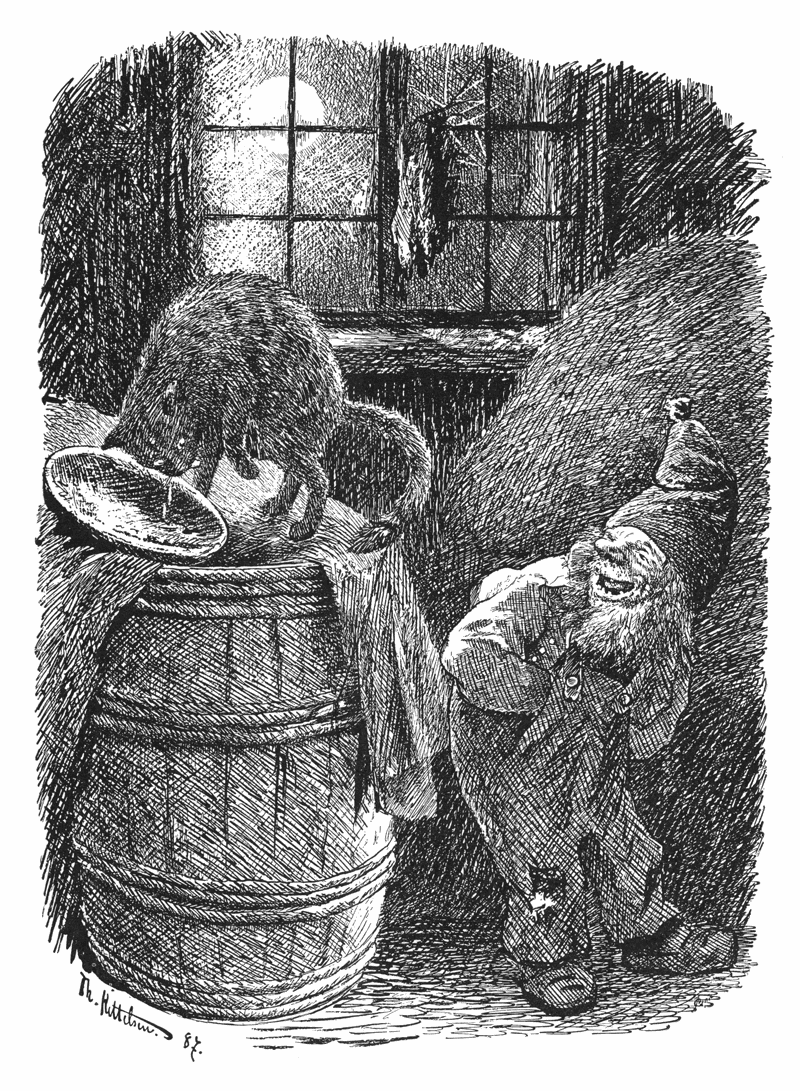
Theodor Kittelsen, "The Nisse" (1887)
In the old Nordic folklore, he existed as a figure who lived very close to people in their everyday existence. He was primarily imagined as an elderly man, not much taller than a child, who bore clear signs of high age, his face yellow as parchment, wrinkled like an old tree root. He often had a full beard and dressed in the everyday clothing of a farmer, in grey wadmal clothes, breeches, a long jersey and a red woolen cap. He was quite hairy, all over the body, as well as unreasonably strong for such a tiny creature.  
Unlike dwarves and the hulder people, who inhabited the hills and forests, nissen had his abode in houses and barns, and served as a guardian, as well as a helper. He was essentially good-natured, and loved conducting practical jokes. It was however, important to be on good terms with him, for he could create a lot of turmoil if he was neglected.
The priest and historian Andreas Faye has written
"Nissen is generally an honorable being. If treated with kindness and respect, he is very willing to be of service. He helps the milkmaid to take care of the animals, and helps the cook to scour, carry water and do other heavy work; she must nevertheless make sure she does not upset him, or forget to supply him with good food and drink – especially around Christmas."
Hence, at Christmas Eve, nissen was presented with the very best of the local cuisine; normally this included a decent portion of Christmas porridge, lefse (a traditional soft, Norwegian flatbread) and beer. If nissen was not satisfied, he would not hesitate to revenge himself by making life unpleasant for the people around him. Well-known is the story about the girl who was so hungry that she ate the porridge herself, instead of giving it to nissen. He later on retaliated by dancing with the girl, till she died.
Other stories may however be of a more humorous form. A legend from Østfold in southeastern Norway tells for instance about a milkmaid who got help from nissen to look after the cows. In addition to rightfully supply him with milk and treats, the maid one day also decided to sow him some new clothes. This gesture however, turned out to backfire on the poor girl. One evening, nissen came to the house, wearing his new ensemble. Rather baffled, the maid received a resignation from the little geezer, who proclaimed he was too  pretty now to struggle and strive in the barn!

The modern day Nisse

Svein Solem
The nisse is frequently depicted with a bowl of Christmas
porridge - in this image portrayed by the Norwegian
illustrator Svein Solem.
Stories and Christmas cards from the late 1800s have helped to spread the image of nissen, and preserved him as an important part of Scandinavian culture. Although he has adapted some features from the commercial, American Santa Claus, the old-fashioned fjøsnisse still remain as perhaps one of the foremost symbols of Norwegian Christmas. Even nowadays many still put out a bowl of porridge for him on Christmas Eve – a survey conducted in 2009 showed that 9% of all Norwegians carry on this 1000 year old tradition.
“På låven sitter nissen” (The nisse in the barn) is a Christmas song with lyrics by Margrethe Munthe. It was first printed in 1911, and still remains as one of the most well-known and beloved Christmas carols, especially among the youngest. It is truly a cheerful and sweet little tune, and tells about nissens fight to keep his Christmas porridge - a bunch of mice are namely trying to steal it. But nissen is an old grump and refuses to share. The first verse goes something like this (a presentment of the melody follows below):
The nisse in the barn has got his Christmas treat, so good and sweet, so good and sweet! 
He nods his head and smiles, oh so happily, cause Christmas porridge, he just loves to eat!

And around him stand the rats that think he’s sharing, and they’re staring, and they’re staring.

They are also very fond of Christmas porridge, and they’re dancing, dancing in a ring!
Eventuelly, nissen threatens to retrieve the cat if the mice do not disappear. As by a stroke of magic the conflict is terminated, and the little rodents flee the scene.


Sources:
  • Faye, Andreas. Norske Folke-Sagn. Norsk Folkeminnelags Forlag. Tredje Oplag. Oslo 1948.
  • Hodne, Ørnulf. Norsk folketro. J.W. Cappelens Forlag. 1999.
  • Hodne, Ørnulf. Vetter og skrømt i norsk folketro. J.W. Cappelens Forlag. 1995.
  • Tidens Krav (18.12.2009). "Nissen får fortsatt  grøt". URL: http://www.tk.no/jul/article4767107.ece